
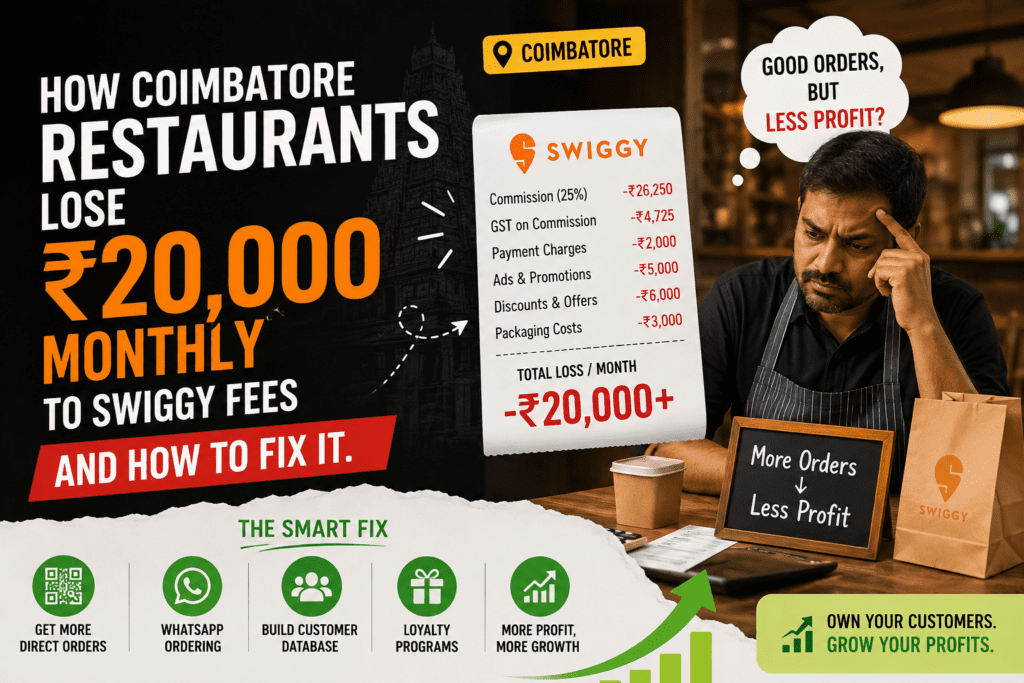
Stop Giving Swiggy 25%+ of Your Hard-Earned Food Revenue
How Coimbatore Restaurants Lose ₹20,000 Every Month to Swiggy Fees – And How to Fix It
Introduction
Food delivery platforms like Swiggy and Zomato have transformed the restaurant industry. They help restaurants reach thousands of customers instantly and generate orders without investing heavily in marketing. However, many restaurant owners in Coimbatore are unknowingly sacrificing a significant portion of their profits to platform commissions, advertising fees, discount programs, and hidden operational costs.
For many small and medium-sized restaurants, this can amount to ₹20,000 to ₹50,000 every month in avoidable expenses.
The good news? There are proven ways to reduce dependency on food delivery aggregators while continuing to enjoy the benefits they provide.
This article explains exactly where your money goes and how you can reclaim your profits.
Understanding the Real Cost of Swiggy Orders
Most restaurant owners focus only on the commission percentage charged by Swiggy. However, the actual cost of acquiring and serving a customer through the platform is much higher.
A typical Swiggy order may include:
Platform commission
GST on commission
Payment gateway charges
Delivery-related fees
Promotional campaign costs
Sponsored listing advertisements
Discount contributions
Packaging expenses
Individually these costs may seem manageable. Combined, they can significantly impact profitability.
A Realistic Example from Coimbatore
Let’s assume a restaurant receives:
300 orders per month through Swiggy
Average order value: ₹350
Monthly revenue through Swiggy:
300 × ₹350 = ₹1,05,000
Typical monthly deductions:
| Expense | Amount |
|---|---|
| Commission | ₹26,250 |
| GST on Commission | ₹4,725 |
| Advertising & Promotions | ₹5,000 |
| Discounts & Offers | ₹6,000 |
| Payment Charges | ₹2,000 |
| Packaging Costs | ₹3,000 |
Total Cost:
₹46,975
Actual Revenue Retained:
₹58,025
That means nearly 45% of the revenue generated through the platform is consumed by associated costs.
Even if only half of these expenses are avoidable, a restaurant could potentially save ₹20,000 or more every month.
Why Restaurants Become Dependent on Swiggy
Most restaurants face the same challenge.
1. Customers Discover Restaurants Through Swiggy
Customers increasingly use delivery apps instead of Google Search.
2. Visibility Requires Advertising
Restaurants often need sponsored listings to appear above competitors.
3. Discounts Become Necessary
When competing restaurants offer discounts, others feel pressured to match them.
4. Customer Data Remains with the Platform
Restaurants rarely receive valuable customer information such as:
Email addresses
Purchase history
Contact preferences
This prevents effective remarketing.
5. Restaurants Pay Repeatedly for the Same Customer
A loyal customer ordering ten times still generates commission fees on every order.
The Hidden Problem: You Don’t Own Your Customer
Imagine owning a restaurant with 1,000 loyal customers.
If those customers order directly from you, your profit margins improve dramatically.
But when customers repeatedly order through Swiggy:
Swiggy owns the customer relationship.
Swiggy controls communication.
Swiggy controls visibility.
Swiggy controls promotions.
The restaurant becomes dependent on the platform for repeat business.
The Smart Solution: Use Swiggy for Discovery, Not Dependency
Successful restaurants don’t completely abandon delivery platforms.
Instead, they use them strategically.
The goal is simple:
Acquire customers through Swiggy. Retain customers directly.
Strategy 1: Create a Direct Ordering Website
Every restaurant should have:
Mobile-friendly website ( CALL US / SMS / CONTACT US )
Digital menu ( CALL US / SMS / CONTACT US )
Online ordering system ( CALL US / SMS / CONTACT US )
UPI payment integration ( CALL US / SMS / CONTACT US )
WhatsApp ordering support ( CALL US / SMS / CONTACT US )
Benefits include:
No commission fees
Better customer experience
Increased profit margins
Full ownership of customer data
Strategy 2: Add QR Codes Everywhere
Place QR codes on:
Dining tables
Bills
Packaging boxes
Carry bags
Flyers
The QR code should direct customers to:
Website
WhatsApp ordering page ( CALL US / SMS / CONTACT US )
Digital menu ( CALL US / SMS / CONTACT US )
Every physical interaction becomes a customer acquisition opportunity.
Strategy 3: Build a WhatsApp Ordering System
Most customers already use WhatsApp daily.
Allow customers to:
Browse menus
Place orders
Receive updates
Contact support
Benefits:
Faster communication
Higher customer retention
No platform commission
A simple WhatsApp Business setup can significantly reduce dependency on third-party platforms. ( CALL US / SMS / CONTACT US )
Strategy 4: Launch a Customer Loyalty Program
Offer rewards such as:
Example:
5 Orders = Free Dessert
10 Orders = ₹200 Voucher
Birthday Reward = Special Offer
Anniversary Reward = Complimentary Item
Customers love recognition and rewards.
The cost of a loyalty reward is often much lower than paying repeated platform commissions. ( CALL US / SMS / CONTACT US )
Strategy 5: Build a Customer Database
Every direct customer should be added to a database.
( CALL US / SMS / CONTACT US )
Collect:
Name
Phone Number
Birthday
Favorite dishes
Order history
Within six months, many restaurants can build a valuable customer database capable of generating repeat orders without advertising spend.
Strategy 6: Focus on Hyperlocal Marketing
Coimbatore offers excellent opportunities for local restaurant marketing.
Promote your restaurant through:
Instagram Reels
( CALL US / SMS / CONTACT US )
Show:
Food preparation
Customer reactions
Signature dishes
Chef stories
Google Business Profile
( CALL US / SMS / CONTACT US )
Maintain:
Updated photos
Reviews
Menus
Operating hours
WhatsApp Marketing
Share:
Daily specials
Weekend offers
Festival menus
Apartment Communities
Partner with:
Residential associations
Gated communities
Corporate offices
These channels often provide a better return on investment than aggregator advertising.
How Much Can a Restaurant Save?
Consider a restaurant currently spending:
₹30,000 per month on commissions and platform-related expenses.
If direct ordering increases from 10% to 50%:
Potential annual savings:
₹20,000 × 12 months
= ₹2,40,000 per year
For larger restaurants, savings can exceed ₹5 lakh annually.
The Ideal Restaurant Growth Model
Instead of depending entirely on food delivery platforms:
Recommended Order Mix
70% Direct Orders
30% Swiggy & Zomato Orders
This approach allows restaurants to:
Maintain visibility
Attract new customers
Improve profitability
Build customer loyalty
Own customer relationships
Final Thoughts
Swiggy and other delivery platforms are powerful tools for customer acquisition. However, they should not become the sole source of restaurant revenue.
Restaurants that build their own ordering channels, customer databases, loyalty programs, and local marketing systems gain greater control over profits and long-term growth. ( CALL US / SMS / CONTACT US )
If your restaurant is losing ₹20,000 or more every month to commissions and platform costs, the solution is not abandoning Swiggy.
The solution is building a direct relationship with your customers.
The restaurants that own their customers today will be the most profitable restaurants tomorrow.
Stop Giving Swiggy 25%+ of Your Hard-Earned Food Revenue
Our direct tap-to-order mobile menu systems let local Coimbatore foodies browse dishes, build their own food cart, and dispatch orders straight to your WhatsApp kitchen desk. NO COMMISSION.